Back to Hazrat Abu Bakr as-Siddiq (ra)
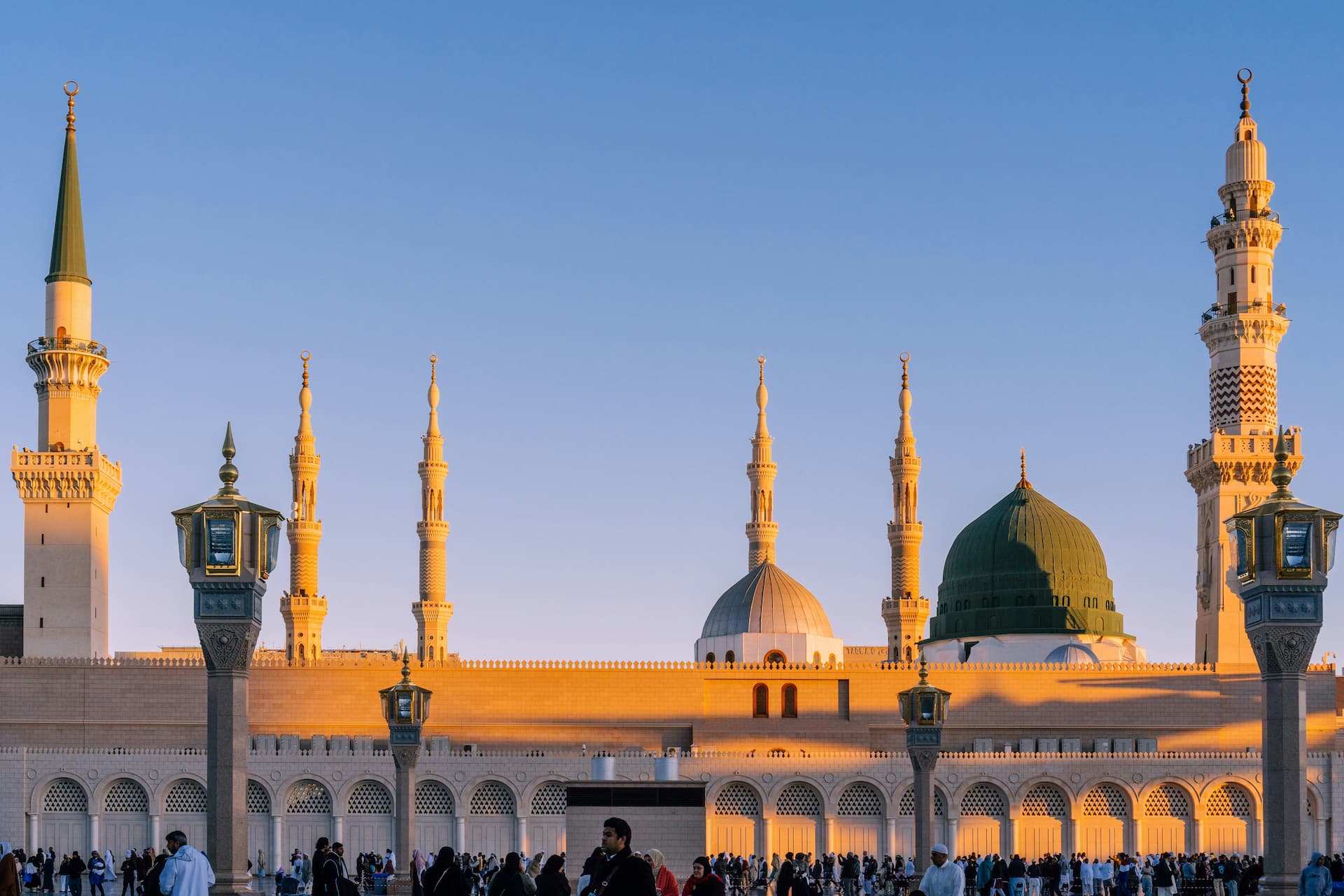
Migration to Medina
From the life of Hazrat Abu Bakr as-Siddiq (ra)
From the life of Hazrat Abu Bakr as-Siddiq (ra)
Similarly, when the Holy Prophet (sa) migrated to Medina, it is stated that Hazrat Abu Bakr (ra) accompanied him. It is written that the oppression of the disbelievers of Mecca upon the Muslims living there was intensifying. During those days, the Holy Prophet (sa) saw a dream in which two Muslims were shown the place where he was to migrate. That place was a barren land surrounded by date palms; however, its name was neither shown, nor mentioned. Nevertheless, seeing its geographic location, the Holy Prophet (sa) personally drew an inference and said, “It will be [towards] Hajar, or Yamama.” This is mentioned in a narration from Sahih Bukhari in which the Holy Prophet (sa) said:
فَذَهَبَ وَهَلِيْ اِلٰي أَنَّهَا الْيَمَامَةُ اَوِ الهَجَرُ، فَاِذَا هِيَ الْمَدِيْنَةُ يَثْرِبُ
(Sahih al-Bukhari, Kitab al-Manaqib, Bab Alamaat al-Nabuwah fi al-Islam, Narration 3622)
“I thought this place to be either Hajar, or Yamama. However, it turned out to be the city of Yathrib, i.e. Medina.”
Yamama is a well-known city in Yemen.
(Farhang-e-Sirat, p. 321, Zawar Academy Publications, Urdu Bazaar Karachi, 2003)
And also, various townships by the name of Hajar can be found in Arabia. A city as well as an area of Bahrain is called Hajar.
(Mu‘jamul Buldan, Vol. 5, p. 452, Dar-ul-Kutub al-Ilmiyyah, Beirut)
Nevertheless, only a short while later, the circumstances changed for the better and fortunate people from the Ansar of Medina started accepting Islam. Subsequently, the Holy Prophet (sa) was informed by way of divine revelation that this was the land of Yathrib, which later became known as Medina.
In relation to this inference of the Holy Prophet (sa), the Promised Messiah (as) said:
“The words of this hadith, which are:
فَذَهَبَ وَهَلِيْ اِلٰي أَنَّهَا الْيَمَامَةُ اَوِ الهَجَرُ، فَاِذَا هِيَ الْمَدِيْنَةُ يَثْرِبُ
“[‘I thought this place to be either Hajar, or Yamama However, it turned out to be the city of Medina, Yathrib’] clearly demonstrate that the inference the Holy Prophet (sa) made regarding the location and place of this prophecy was incorrect.”
(Izala-e-Auham, Ruhani Khazain, Vol. 3, p. 472)
The Holy Prophet (sa) permitted and guided the oppressed companions and Muslims living in Mecca to migrate towards Medina. Hence, the Muslims of Mecca started migrating to Medina. On the other hand, the migration increased following the second pledge at Aqabah and entire households and areas were left empty.
These circumstances enraged the barbaric chiefs of Mecca even further and they started boiling with anger. Upon this, they took another step and prevented these oppressed individuals from migrating and new methods of oppression were adopted. At times, they let the husband migrate, but would take away his wife and children from him. At times, they would demand the belongings and wealth of the person be given to them, on the basis that they earned it in their city and so if they wished to leave, they must hand over all their wealth. At times, they would stop them by urging them to go visit their mother before they depart, but then along the route they would tie them up with ropes and lock them up in a room.
(Subul al-Huda wa al-Rishad, Vol. 3, pp. 224-227, Dar-ul-Kutub al-Ilmiyyah, Beirut, 1993)
However, the devoted party of believers, who were saturated with the wealth of faith, and were intoxicated in their love for Islam, continued to undertake the migration towards Medina. Nearly all those who were able to make the migration from Mecca had done so. Only those Muslims who were very weak and powerless remained behind, regarding whom it is mentioned in the Holy Quran:
اِلَّا الْمُسْتَضْعَفِيْنَ مِنَ الرِّجَالِ وَ النِّسَآءِ وَ الْوِلْدَانِ لَا يَسْتَطِيْعُوْنَ حِيْلَةً وَّ لَا يَهْتَدُوْنَ سَبِيْلًا
“Except such weak ones among men, women and children, as are incapable of adopting any plan or of finding any way.” (Surah al-Nisa, Ch.4: V.99)
Aside from them, the Holy Prophet (sa) himself was still in Mecca awaiting divine permission, and Hazrat Ali (ra) was also in Mecca. Hazrat Abu Bakr Siddiq (ra) went to seek permission to migrate, but he was told, “Wait, for I am hopeful that I too shall be granted permission.” Or, according to another narration the Holy Prophet (sa) stated, “Do not rush, for Allah the Almighty may well arrange for someone to accompany you.”
Thereupon, Hazrat Abu Bakr (ra) submitted, “O Messenger (sa) of Allah, may my parents be sacrificed for your sake, will you also be granted permission to migrate?” It was as though the sorrow of separation from the Holy Prophet (sa) due to the migration had been alleviated.
Hearing this glad tiding, Hazrat Abu Bakr (ra) returned joyfully and abandoned the idea of migrating. Nevertheless, he very wisely purchased two camels which were fed a special diet in order to prepare them for the unpredictable journey of the migration.
(Sahih al-Bukhari, Kitab al-Kifalah, Bab Jawar Abi Bakr fi Ahd al-Nabawi wa Uqdahu, Hadith 2297) (Al-Khalifat-ul-Awwal Abu Bakr Siddiq, al-Sallabi, p. 45, Dar-ul-Ma‘rifah, Beirut, 2006)
Narration 1
There are also various narrations with regard to which direction the Holy Prophet (sa) went when he left his home. From one of the narrations, it seems that the Holy Prophet (sa) and Hazrat Abu Bakr (ra) left their homes respectively and met at one place and then headed towards the Cave Thaur.
(Tarikh al-Tabari, Vol. 1, p. 568, Tarikh Qabal Al-Hijrat, Dar-ul-Kutub al-Ilmiyyah, Beirut, 1987)
Narration 2
In another narration, it states that the Holy Prophet (sa) left his house and headed towards the Cave Thaur. After a short while, Hazrat Abu Bakr (ra) came to the Holy Prophet (sa) house and Hazrat Ali (ra) informed him that the Holy Prophet (sa) had already left and that he should go behind him. And so, Hazrat Abu Bakr (ra) followed after him.
(Al-Sirat al-Halabiyyah, Vol. 2, p. 47, Dar-ul-Kutub al-Ilmiyyah, Beirut, 2008)
This narration seems very weak. It seems from this that the Holy Prophet (sa) waited for Hazrat Abu Bakr (ra) and he got late. Furthermore, [it seems from this] that Hazrat Abu Bakr (ra) had no knowledge of where the Holy Prophet (sa) went and it was Hazrat Ali (ra) who had to tell him. It is not possible at all that such an important and confidential event as the migration took place and Hazrat Abu Bakr (ra), who was extremely wise and responsible would show such carelessness.
Thus, in comparison to this, the other narration which is more commonly found in the [Islamic] literature seems to be more correct and accurate. According to the other narration, the Holy Prophet (sa) left his house and went straight to the house of Hazrat Abu Bakr (ra). From there the Holy Prophet (sa) along with Hazrat Abu Bakr (ra) went to Cave Thaur.
(Al-Sirat al-Nabawiyyah, Ibn Hisham, p. 343, Dikr Hijrat-e-Rasool, Dar-ul-Kutub al-Ilmiyyah, Beirut, 2001)
In any case, there are different narrations about what time the Holy Prophet (sa) left and they vary; some narrations state that the Holy Prophet (sa) left in the early part of the night, whereas others state that he left in the middle of the night, and some state that he left in the last part of the night. Nonetheless, I will present the different narrations about what time the Holy Prophet (sa) left the house.
According to one narration, the Holy Prophet (sa) left his house in the last third of the night. Regarding this, Muhammad Husain Haykal writes:
“Owing to the heedlessness of the idolaters, Prophet Muhammad (sa) left in the last third of the night and made his way towards the house of Hazrat Abu Bakr (ra). From there, both of them left from the back door of his house, and travelled south towards Cave Thaur.”
(Hayat-e-Muhammad, Muhammad Husayn Haykal, pp. 223-224, Vol. 10, Hijrat-e-Rasul, Dar-ul-Ma‘arif)
In another narration, it is mentioned that he left in the middle of the night. In Dalail al-Nubuwwah, it is written that the Holy Prophet (sa) and Hazrat Abu Bakr (ra) left for Cave Thaur in the middle of the night.
(Dalail al-Nabuwwah, Bayhaqi, pp. 465-466, Dar-ul-Kutub al-Ilmiyyah, Beirut, 2002)
In Madarij al-Nubuwwah, it is mentioned, “When the Holy Prophet (sa) decided that he would migrate the next morning, that evening he said to Hazrat Ali Murtaza, may Allah honour him, ‘Sleep in my bed tonight, so the idolaters do not get suspicious and learn about the plan.’”
(Madarij al-Nubuwwah, Sheikh Abdul Haq Muhaddith Dehlvi, Urdu translation by Ghulam Muin-ul-Din Naimi, Vol. 2, p. 83, Shabir Brothers, Urdu Bazar, Lahore)
According to the Promised Messiah (as), the Holy Prophet (sa) left his home in the morning. The Promised Messiah (as) states:
“None of the opponents saw the Holy Prophet (sa) when he left, even though it was morning and all of the opponents were stood surrounding the house of the Holy Prophet (sa). It was just as God Almighty stated in Surah Ya Sin that a covering was placed over the eyes of those unfortunate people and the Holy Prophet (sa) left them in a state that they were utter humiliated.”
(Surma Chashm-e-Arya, Ruhani Khazain, Vol. 2, p. 66 [footnote])
In any case, there are various narrations, but they all state that the disbelievers had no knowledge.
The narration Hazrat Musleh-e-Maud (ra) has mentioned is as follows:
“When the people of Mecca were gathering outside the house of the Holy Prophet (sa) in order to kill him, the Holy Prophet (sa) was leaving in the darkness of the night with the intention to migrate from there. The people of Mecca most certainly would have suspected that the news of their plan had reached the Holy Prophet (sa), but despite that, when the Holy Prophet (sa) left in front of them, they thought it was someone else. Hence, instead of attacking the Holy Prophet (sa), they began to hide, so that their plans would not be revealed to the Holy Prophet (sa). Prior to this night, Abu Bakr (ra) had also been informed about migrating with the Holy Prophet (sa), and so he met with the Holy Prophet (sa) and after a short while they departed from Mecca.”
(Dibacha Tafsir-ul-Quran, Anwar-ul-Ulum, Vol. 20, pp. 222-223)
Hazrat Mirza Bashir Ahmad Sahib (ra) has written that the Holy Prophet (sa) left in the early part of the night. Regarding this, he states:
“At that time, the besiegers were present in front of the Holy Prophet (sa) door. However, since they did not anticipate that the Holy Prophet (sa) would leave his home so early in the night, at that time, they were in such a state of unawareness that the Holy Prophet (sa) left right through their midst, leaving them in their ignorance, and they had not a clue. Now, the Holy Prophet (sa) was silently, but quickly, passing through the streets of Mecca and it was not long before he reached the outskirts of the town and started towards the Cave of Thaur. The entire matter had been pre-settled with Hazrat Abu Bakr (ra), who also met the Holy Prophet (sa) en-route.”
(Sirat Khatamun-Nabiyyin, Hazrat Mirza Bashir Ahmad (ra), p. 237)
Regarding this incident, the Promised Messiah (as) states:
“When, owing to unforeseen circumstances, the Holy Prophet (sa) had to leave his hometown and the opponents had surrounded his blessed house with the intention of killing him, a dear relative – who was imbued with love and faith in the prophet – on the orders of the Holy Prophet (sa), laid down on his bed without any fear of death; he hid his face so as not to arouse the suspicion of the enemy spies which would hint that the Holy Prophet (sa) had left. They remained content, waiting for the opportunity to kill him.
كس بهرِ كَسے سر نَدِهَد جان نَفَشَانَد عِشق است كہ اِيں كار بَصَدْ صِدق كُنَانَد
“Meaning, ‘No one willingly sacrifices their life for another. It is only on account of true sincerity that can make a man do this happily and willingly.’” (Surma Chashm-e-Arya, Ruhani Khazain, Vol. 2, pp. 64-65 footnote)
The Promised Messiah (as) states:
“When the disbelievers of Mecca intended to murder the Holy Prophet (sa), Allah the Almighty informed His virtuous prophet of their evil plot and instructed him to migrate from Mecca to Medina, at the same time He also gave him the glad tiding of his return following his future victory with divine help. It was in the afternoon on a Wednesday, during days of severe heat, when this trial was uncovered and revealed by Allah.”
(Surma Chashm-e-Arya, Ruhani Khazain, Vol. 2, p. 64 footnote)
Whilst mentioning these details, Hazrat Musleh-e-Maud (ra) states:
“The companions of the Holy Prophet (sa) had begun preparations to migrate. One family after another would begin to disappear from Mecca. Now, even those who were awaiting the sovereignty of God Almighty became even more bold [that God’s help was near], and at times, the houses of an entire street of Mecca would be locked at night, and come the morning, when the people of the city would find it to be very quiet, upon enquiry, they would learn that all the residents on the street had migrated to Medina. This deep impact of Islam which had been growing from within Mecca, had left the Meccans astonished. Eventually, Mecca had been vacated by the Muslims, and aside from a few slaves, only the Holy Prophet (sa), Hazrat Abu Bakr (ra) and Hazrat Ali (ra) had remained in Mecca.”
(Dibacha Tafsir-ul-Quran, Anwar-ul-Ulum, Vol. 20, p. 222)
Hazrat Musleh-e-Maud (ra) further says:
“The idolaters of Mecca naturally harboured greater malice and enmity for the Holy Prophet (sa) than for anyone else because they witnessed with their own eyes that as a result of his teachings, opposition to idol-worship was continuing to spread. They believed that if they assassinated him, the rest of his community would automatically fall apart. For this reason, they would persecute the Holy Prophet (sa) more than anyone else and hoped that one way or another, he would desist from his claims. In spite of all these difficulties, the Holy Prophet (sa) instructed his companions to migrate, but continued to suffer these trials and difficulties himself, and did not migrate from Mecca, as he had not yet received permission from Allah Almighty to do so. Hence, when Hazrat Abu Bakr (ra) asked if he should undertake the migration, the Holy Prophet (sa) replied:
عَلٰي رِسْلِكَ فَاِنِّيْ اَرْجُو اَنْ يُّؤْذَنَ لِيْ
“‘Wait, for I hope that I too shall be granted permission.’”
(Sirat-ul-Nabi, Anwar-ul-Ulum, Vol. 1, p. 489)
The disbelievers [of Mecca] convened in Dar al-Nadwah to secretly plot against the Holy Prophet (sa). Regarding this, it is recorded that the chieftains of Mecca were enraged and agitated that the Muslims were slipping out of their hands to safety. For this reason, they gathered in Dar al-Nadwah.
Allama Ibn Ishaq writes:
“When the Quraish observed that a group of supporters had joined the Holy Prophet (sa) who were neither from the Muslims of Mecca, nor did they belong to their region, and that other companions of the Holy Prophet (sa) were migrating towards those people, the Quraish realised that the Muslims had found safety with him, and that they, i.e. the people of Medina had given them refuge. They became concerned that the Holy Prophet (sa) would migrate to them, and that they would then gather against them for war. Therefore, they convened in Dar al-Nadwah to deliberate upon the matter. This was the house of Qusay bin Kilab that was reserved for when the Quraish needed to deliberate upon a decision. Whenever they felt danger from the Holy Prophet (sa), they would gather in this place for consultation.”
In another narration, it is related by Hazrat Abdullah bin Abbas (ra), “When the Quraish decided to gather, they pledged that they would convene in Dar al-Nadwah and consult with each other about the Holy Prophet (sa). The day which they had pledged to convene is known as Yaum al-Zahmah. Iblis [i.e. the devil] manifested before them in the appearance of an old man” – what is meant by this is that a man came before them who possessed the attributes of Iblis. “He was wrapped in a cloak and was standing at the door of Dar al-Nadwah. The people did not recognise him. When they saw this old man standing at the door, they asked, ‘Who is this old man?’ He replied, ‘I am an old man from among the people of Najd, and I have heard what you people have pledged to do. I have come to hear what you have to say. Perhaps you will find a useful suggestion or something of benefit.’” This is what he said regarding himself.
“The people agreed and allowed him to enter. He entered along with all the others. The gathering consisted of a large party of chieftains of the Quraish, including prominent names like Utbah bin Rabiah, Shayba bin Rabiah, Abu Sufyan bin Harb, Tuaima bin Adi, and others like Abu Jahl [Amr] bin Hisham, the two sons of Hajjaj and many others. There were also some chieftains who were not from among the Quraish.
“When everyone had gathered and it came time to present suggestions, one person suggested that he (Muhammad (sa)) should be imprisoned and locked up behind iron bars. Then, they would wait for his death, just as they did with two poets; the likes of Zuhair and Nabigha and other poets that had passed.” In other words, wait for his demise, just as they did with two poets, Zuhair and Nabigha, before him. This was planned for the Holy Prophet (sa) as well, i.e. to wait for his demise as was done before to others.
“Upon hearing this suggestion, the old man from Najd said, ‘No. I swear by Allah, according to me, this suggestion is not appropriate. By Allah, if you people imprison him, this news will reach his companions even from behind closed doors. Then, it is likely that they will launch a sudden assault on you and free him from your custody. Following that, they will increase their numbers with his help and defeat you. Thus, you must think of another strategy.’ Upon this, another person suggested, ‘We should exile him from our city, after which we will not associate with him and will not be concerned about where he goes. When he leaves us and we rid ourselves of him, then our circumstances will improve and we will be able to live in the same condition as we once did.’
“To this, the old man from Najd remarked, ‘No. I swear by Allah that this suggestion is not appropriate. Do you not see how great his message and how pleasant his speech is? He is able to win the hearts of the people with what he has brought. I swear by Allah that if you adopt this strategy, you will not live in peace, because he will go unto another Arab tribe and win their hearts with his words. They will become his followers and join forces with him against you. They will then advance toward you, disgrace you in your own city, seize control of your matters from your own hands and treat you however they like. Thus, you must think of another strategy.’
“In response, Abu Jahl said, ‘My suggestion is that a young and strong individual of status and lineage from each tribe should be chosen. Each of them should be handed a sharp sword. They all should go to him and attack him as one force and kill him. Thereby, we will finally be free from him. By killing him in this manner, his blood would be on all the tribes, and the tribe of Banu Abd Manaf would not be able to combat against all the tribes for retribution. Accordingly, they will settle for blood money, and we will pay them the amount due.’
“The old man from Najd replied, ‘If there is a viable suggestion, then it is the suggestion of this man. All the other suggestions are futile. Thus, everyone agreed with this suggestion and left.’”
(Al-Sirat Al-Nabawiyyah, ibn Hisham, pp. 340-342, Dikr Hijrat-e-Rasool, Dar-ul-Kutub al-Ilmiyyah, Beirut, 2001)
On the other hand, Allah the Almighty informed the Holy Prophet (sa) about all of this, as Allah states:
وَاِذْ يَمْكُرُ بِكَ الَّذِيْنَ كَفَرُوْا لِيُثْبِتُوْكَ اَوْ يَقْتُلُوْكَ اَوْ يُخْرِجُوْكَ وَ يَمْكُرُوْنَ وَ يَمْكُرُ اللّٰهُ وَ اللّٰهُ خَيْرُ الْمٰكِرِيْنَ
“And [remember the time] when the disbelievers plotted against thee that they might imprison thee or kill thee or expel thee. And they planned and Allah [also] planned, and Allah is the best of planners.” (Surah al-Anfal, Ch.8: V.31)
Along with this, Angel Gabriel informed the Holy Prophet (sa) of his permission to migrate.
(Subul al-Huda wa al-Rishad, Vol. 3, p. 232, Dar-ul-Kutub al-Ilmiyyah, Beirut, 1993)
Hazrat Mirza Bashir Ahmad Sahib (ra) has mentioned this incident in Sirat Khataman Nabiyyin as follows:
“In the darkness of the night, the cruel Quraish from various tribes had besieged the home of the Holy Prophet (sa) with their bloodthirsty intentions. They were waiting for dawn, or for the Holy Prophet (sa) to come out of his home, so as to launch a sudden assault and assassinate him. Various trusts belonging to the disbelievers were still with the Holy Prophet (sa), for despite their extreme enmity, many people would often entrust their belongings to the Holy Prophet (sa) on account of his truthfulness and trustworthiness. Therefore, the Holy Prophet (sa) explained the accounts of these trusts to Hazrat Ali (ra), and instructed him not to leave Mecca until these trusts were returned. Then he instructed, ‘You lie on my bed,’ and assured him that no harm would come to him. He lay down and the Holy Prophet (sa) covered him with his red-coloured mantle. After this, the Holy Prophet (sa) invoked the name of Allah, and left his home. At that time, the besiegers were present in front of the Holy Prophet (sa) door. However, since they did not anticipate that the Holy Prophet (sa) would leave his home so early in the night, at that time, they were in such a state of unawareness that the Holy Prophet (sa) left right through their midst, leaving them in their ignorance, and they had not a clue […] On the other hand, the Quraish who had besieged the home of the Holy Prophet (sa), would peer through after short intervals, and upon seeing Hazrat Ali (ra) who was in fact lying in the place of the Holy Prophet (sa), they would find comfort. But the next morning, they found out that their prey had slipped their hands. Upon this, they franticly ran here and there, searched the streets of Mecca, looked in the homes of companions, but nothing was to be found. In their rage, they took hold of Hazrat Ali (ra) and beat him somewhat.”
(Sirat Khatamun-Nabiyyin, Hazrat Mirza Bashir Ahmad (ra), pp. 236-237)
Upon receiving permission to migrate, the Holy Prophet (sa), taking all the necessary precautions, went to Hazrat Abu Bakr’s (ra) house at midday, when most of the residents of Mecca would remain in their homes and not go to meet one another. The Holy Prophet (sa) took further precaution by keeping his face, head etc. covered owing to the intense heat. When the Holy Prophet (sa) reached near Hazrat Abu Bakr’s (ra) house, someone informed Hazrat Abu Bakr (ra) – according to the narration of Al-Tabrani and Fath al-Bari, it was Hazrat Asma (ra) who informed him – that it appeared as if the Holy Prophet (sa) was approaching.
Hazrat Abu Bakr (ra) stated, “May my mother and father be scarified for his sake! By God, there must be a particular reason as to why the Holy Prophet (sa) is coming at this hour of the day.” Thereafter, Hazrat Abu Bakr (ra), in a state of anxiousness, hurried outside in a manner of utmost devotion. When the Holy Prophet (sa) entered inside the house, Hazrat Aisha (ra) and Hazrat Asma (ra) were present inside the room. The Holy Prophet (sa) stated to Hazrat Abu Bakr (ra) that he should send out whoever was with him. Upon this, Hazrat Abu Bakr (ra) submitted, “O Messenger (sa) of Allah! Only my two daughters are here at this time and no one else.” And according to another narration, Hazrat Abu Bakr (ra) submitted, “O Messenger (sa) of Allah! Only the members of your household are present in the house and no one else.”
Upon this, the Holy Prophet (sa) stated, “Abu Bakr! I have been granted permission for migration.” Hazrat Abu Bakr (ra) immediately submitted, “O Messenger (sa) of Allah! Will I be able to accompany you?” The Holy Prophet (sa) stated, “Yes.”
This is a narration from Bukhari.
(Sahih al-Bukhari, Kitab al-Buyu, Narration 2138) (Sahih al-Bukhari, Kitab Manaqib al-Ansar, Narration 3905) (Fath al-Bari bi-Sharh Sahih al-Bukhari, Vol. 7, p. 277, Dar al-Riyan li al-Turath al-Qahirah, 1986)
Upon hearing this, Hazrat Abu Bakr (ra) began to cry out of happiness. Hazrat Aisha (ra) relates that this was the first time she realised that someone could cry out of happiness as well.
(Al-Sirat Al-Nabawiyyah, ibn Hisham, p. 343, Dikr Hijrat-e-Rasool, Dar-ul-Kutub al-Ilmiyyah, Beirut, 2001)
Subsequently, the entire plan and arrangements for the migration were formulated. Hazrat Abu Bakr (ra) submitted, “O Messenger of Allah! I had purchased two camels for this very purpose. Take one of them.” The Holy Prophet (sa) replied, “I will purchase it for a price.”
Upon the Holy Prophet (sa) insistence of paying for the camel, Hazrat Abu Bakr (ra) was left with no option but to accept. He had bought the two camels for 800 dirhams, and so the Holy Prophet (sa) bought one of them for 400 dirhams. According to one narration, the Holy Prophet (sa) bought the camel for 800 dirhams.
(Sahih al-Bukhari, Kitab Manaqb al-Ansar, Narration 3905) (Al-Tabaqat al-Kubra li-ibn Saad, Vol. 1, p. 382, Dar-ul-Kutub al-Ilmiyyah, Beirut, 2012) (Sharh Zurqani Ala al-Mawahib al-Diniyyah, Vol. 2, pp. 105-106, Dar-ul-Kutub al-Ilmiyyah, Beirut, 1996)
It was then settled that the first stop would be Cave Thaur, where they would spend three days. It was also decided that a person would accompany them who was an expert in all the known and unknown routes of the desert around Mecca. For this, they spoke to Abdullah bin Uraykit, who although was an idolater, was a noble and trustworthy person whom they could rely on. Biographers [of the Holy Prophet (sa)] state that he did not accept Islam, but according to one narration, he accepted Islam later on. Nevertheless, three camels were given to him and he was told to come to Cave Thaur in the morning after exactly three days. Hazrat Abdullah bin Abi Bakr (ra), who was an intelligent young man, was assigned the duty that he would go around the various gatherings in Mecca each day and assess the situation. He would then go to Cave Thaur in the evening and give the reports. Hazrat Abu Bakr (ra) had a wise and responsible slave named Amir bin Fuhayrah, who was assigned the task that he would graze his goats around Cave Thaur and in the evening, he would milk the goats and provide them with milk. Then, after designating the time for leaving Mecca, the Holy Prophet (sa) quickly left Hazrat Abu Bakr’s (ra) house and returned home.
(Tarikh al-Khamees, Vol. 2, p. 7, Dikr Khuroojahusa ma‘a Abi Bakr Min Mecca, Dar-ul-Kutub al-Ilmiyyah, Beirut, 2009) (Al-Raheeq al-Makhtum, Safi-ul-Rahman, p. 165, Dar-ul-Ghada al-Jadid, 2018) (Sharh al-Zurqani, Vol. 2, p. 129, Dar-ul-Kutub al-Ilmiyyah, Beirut, 1996)
After returning home, he informed Hazrat Ali (ra) of his plan to migrate and assigned him a precarious task in that he was to sleep in the Holy Prophet (sa) bed, with his green – or, according to another narration, red hadrami mantle – which the Holy Prophet (sa) used whilst sleeping. He assured this devoted servant the glad tidings of support from Allah by saying, “Do not worry. Sleep in my bed with complete contentment. The enemy will not be able to harm you in the slightest.” The Holy Prophet (sa), who was the most truthful and trustworthy, was worried about the possessions he had been entrusted with by the people of Mecca, and owing to this responsibility, he said to join him after he had returned the possessions, i.e. he told Hazrat Ali (ra) to come to Medina once he had returned the possessions. Hazrat Ali (ra) remained in Mecca for three days and gave the possessions that had been entrusted to the Holy Prophet (sa) back to their owners. When he completed this task, he joined the Holy Prophet (sa) when he was in Quba. After this, the Holy Prophet (sa) stepped out of his house, where the elect brave individuals had gathered with their bloodthirsty intentions. With their swords in their hands, they kept watch over the Holy Prophet (sa) house, waiting for nightfall when they would launch a sudden attack and finish him off with one strike. Abu Jahl, who was their ringleader, was saying in an arrogant and mocking way, “Muhammad (sa) says that if you follow him, you will become the kings of the Arabs and non-Arabs alike, and that you will be raised up after your death, and that you will receive gardens like that of Jordan. If you do not do this, then there will be bloodshed amongst you.” The Holy Prophet (sa) came outside and said, “Indeed, this is what I say, and recited the following verses of Surah Ya Sin:
يٰس۔ وَ الْقُرْاٰنِ الْحَكِيْمِ۔ اِنَّكَ لَمِنَ الْمُرْسَلِيْنَ۔ عَلٰي صِرَاطٍ مُّسْتَقِيْمٍ۔ تَنْزِيْلَ الْعَزِيْزِ الرَّحِيْمِ۔ لِتُنْذِرَ قَوْمًا مَّآ اُنْذِرَ اٰبَاؤُهُمْ فَهُمْ غٰفِلُوْنَ۔ لَقَدْ حَقَّ الْقَوْلُ عَلٰٓي اَكْثَرِهِمْ فَهُمْ لَا يُؤْمِنُوْنَ۔ اِنَّا جَعَلْنَا فِيْٓ اَعْنَاقِهِمْ اَغْلٰلًا فَهِيَ اِلَي الْاَذْقَانِ فَهُمْ مُّقْمَحُوْنَ۔ وَ جَعَلْنَا مِنْۢ بَيْنِ اَيْدِيْهِمْ سَدًّا وَّ مِنْ خَلْفِهِمْ سَدًّا فَاَغْشَيْنٰهُمْ فَهُمْ لَا يُبْصِرُوْنَ
The translation is: “Ya Sin [O Leader]. By the Quran, full of wisdom, thou art indeed [one] of the Messengers, on a right path. [This is] a revelation of the Mighty, the Merciful, that thou mayest warn a people whose fathers were not warned, and so they are heedless. Surely, the word has proved true against most of them, for they believe not. We have put round their necks collars reaching to the chins, so that their heads are forced up. And We have set a barrier before them and a barrier behind them, and have covered them over, so that they cannot see.” [Surah Ya Sin, Ch.36: V.2-10]
The Holy Prophet (sa) then left in the midst of them and they were utterly helpless. It was the power of Allah the Almighty that not a single person saw him leave. In fact, they would constantly peer inside and become content that Muhammad (sa) was sleeping on his bed.
(Al-Sirat al-Nabawiyyah, Ibn Hisham, p. 342, 348 Dikr Hijrat-e-Rasul, Dar-ul-Kutub al-Ilmiyyah, Beirut, 2001) (Muhammad (sa) Rasulullahi Walladhina Ma‘ahu, Vol. 3, p. 74, Baab Al-Hijrat, Egypt) (Al-Tabaqat al-Kubra li-ibn Saad, Vol. 1, p. 176, Dar-ul-Kutub al-Ilmiyyah, Beirut, 2012)
There is a narration in Bukhari which states that on the way, many of the caravans that would pass by would recognise Hazrat Abu Bakr (ra) as he would often embark on trade journeys using those routes. They would enquire who he was with and Hazrat Abu Bakr (ra) would reply, “He shows me the way.”
هَذَا الْرَّجُلُ يَهْدِيْنِيْ الْسَّبِيْلَ
In other words, “This person guides me to the right path.” People would assume that the Holy Prophet (sa) was his guide whereas Hazrat Abu Bakr (ra) meant in terms of spiritual guidance.
(Sahih al-Bukhari, Kitab Manaqib al-Ansar, Bab Hijrat al-Nabisa wa Ashabih ila al-Medina, Hadith 3911)
With regard to this, Hazrat Mirza Bashir Ahmad Sahib (ra) writes:
“Since the profession of Hazrat Abu Bakr (ra) was that of a businessman, he would travel this route to and fro continuously. Most people recognised him, but were not familiar with the Holy Prophet (sa). As such, they would enquire of Hazrat Abu Bakr (ra), ‘Who is the man ahead of you?” Hazrat Abu Bakr (ra) would respond:
هَذَا يَهْدِيْنِيْ الْسَّبِيْلَ
‘This is my guide.’ They would think that he is a guide hired by Hazrat Abu Bakr (ra) to direct his route, but the actual intent of Hazrat Abu Bakr (ra) was something else.”
(Sirat Khatamun-Nabiyyin, Hazrat Mirza Bashir Ahmad (ra), p. 242)
With regard to reaching their final destination, it is written that on the Monday, after travelling for eight days, with the help of God, they finally reached Quba which was en route to Medina. It is mentioned in hadith that the Holy Prophet (sa) was born on a Monday, he left Mecca on a Monday, he arrived in Medina on a Monday and passed away on a Monday.
(Mustafa Abd al-Wahid, Subul al-Huda wa al-Rashad fi Sirat Khair al-Ibad, Vol. 3, Jama‘ Abwab al-Hijrah ila al-Medina [Beirut, Lebanon: Dar al-Kutub al-‘Ilmiyyah, 1993], p. 253) (Sirat Khatamun-Nabiyyin, Hazrat Mirza Bashir Ahmad (ra), p. 243)
Quba was the name of a well and the village thus became commonly known as Quba where the Ansar tribe of Banu Amr bin Auf lived. This village was situated at a distance of two miles from Medina.
(Shihab al-Din Yaqut Ibn Abd Allah al-Hamawi, Mu‘jam al-Buldan, Vol. 4, Zair Lafz ‘Quba’ [Beirut, Lebanon: Maktabah al-Misriyyah, 2014], p. 77)
According to other opinions, Quba was situated at a distance of three miles from Medina and was also known as Aliya.
(Sayyid Fadl al-Rahman, Farhang-e-Sirat [Karachi, Pakistan: Zawwar Academy Publications, 2003], p. 230)